
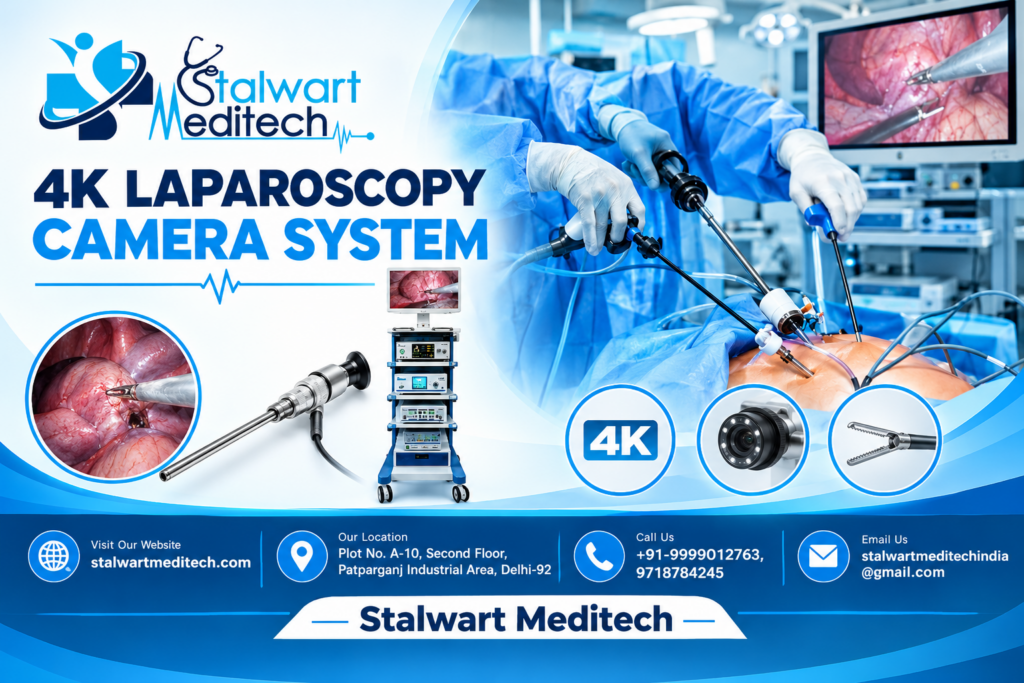
Minimally invasive surgery depends on what the surgical team can see on screen. A 4K laparoscopy camera system is the imaging chain that captures, processes and displays video at ultra-high-definition resolution during laparoscopic procedures. For hospitals, surgical centres and biomedical teams researching imaging equipment, the real question is not simply “is it 4K?” but whether every part of the system works together reliably in your operating room.
This guide explains how these systems operate, what they contain, how they compare with Full HD, and which practical factors matter when evaluating one. For a wider overview, see our guide to laparoscopy equipment types, components and selection.
Quick Answer: What Is a 4K Laparoscopy Camera System?
A 4K Laparoscopy Camera System is a surgical imaging setup that captures and displays high-resolution video during laparoscopic procedures. It typically includes a camera head, a camera control unit, a compatible 4K monitor, a laparoscope and a light source. Actual image quality depends on how well these components are matched and configured.
How Does a 4K Laparoscopy Camera System Work?
The process follows four basic steps:
- Illumination. A light source sends light through a light cable and the laparoscope to the surgical site. Without adequate, well-matched illumination, even a high-resolution sensor cannot produce a good image.
- Image capture. The laparoscope’s optics relay the image to the camera head, where an image sensor (commonly a CMOS sensor) converts light into an electronic signal.
- Image processing. The camera control unit (CCU), or an integrated processor, converts that signal into a video image and applies settings such as white balance, brightness and contrast.
- Display. The processed video travels through cables and connectors to a surgical monitor, and may also be sent to recording or streaming equipment.
Because each step affects the next, the image a surgeon sees is only as good as the weakest link in the chain.
Key Components of a 4K Laparoscopy Camera System
Component lists and configurations differ between models and manufacturers, so always confirm what is included in a quoted system.
| Component | Role | What to confirm |
| Camera head / imaging sensor | Captures the image relayed by the laparoscope | Sensor type, handling, cable and coupler compatibility |
| Camera control unit (processor) | Processes the signal and manages image settings | Supported resolutions, adjustment options, software features |
| 4K medical monitor | Displays the image | Native 3840 × 2160 resolution, input types, intended medical use |
| Laparoscope and optical accessories | Carry light in and relay the image out | Diameter, viewing angle, compatibility with the camera |
| Light source and light cable | Illuminate the surgical field | Connector compatibility and brightness suitable for the setup |
| Video cables, connectors, recorders | Move and store the video signal | Required formats and bandwidth for 4K output |
Important Features to Look for in a 4K Laparoscopy Camera System
Resolution is only one specification. Evaluate the following together:
- Resolution and detail: 4K UHD usually means 3840 × 2160 pixels, but the display and the rest of the chain must support it.
- Sensor quality and low-light performance: Ask how the system performs under representative operating conditions.
- Colour reproduction and white balance: Consistent, natural colour helps teams distinguish tissue types; check how white balance is set and maintained.
- Image processing: Review available adjustments and whether they suit your surgeons’ preferences.
- Ergonomics: Weight, balance and cable handling affect comfort during longer procedures.
- Outputs and recording: Confirm video output types and any recording options for teaching or documentation.
- Compatibility: Verify fit with your laparoscopes, monitors and light sources.
- Reprocessing requirements: Check which parts need cleaning, disinfection or sterilization, and how.
- Serviceability: Look at technical support, spare parts and repair processes.
A system with strong specifications on paper can still disappoint if one component limits the chain. Judge the whole system, not the headline number.
Benefits of 4K Imaging in Modern Laparoscopic Surgery
When the complete system supports 4K, potential practical benefits include:
- Greater image detail than Full HD, since 4K contains four times as many pixels.
- Clearer visualization of fine anatomical structures on a suitable display.
- Better shared viewing for the surgical team, particularly on larger monitors.
- Teaching and documentation support, where recording and storage are available.
- Integration opportunities in operating rooms equipped for video routing and archiving.
These are technical imaging advantages. They are not proven clinical outcomes. Higher resolution should not be assumed to reduce complications, shorten operating time or speed recovery; those questions require clinical evidence and surgeon judgment.
4K vs Full HD Laparoscopy Camera Systems
4K UHD commonly refers to 3840 × 2160 resolution, while Full HD commonly refers to 1920 × 1080.
| Factor | 4K UHD | Full HD |
| Resolution | 3840 × 2160 | 1920 × 1080 |
| Image detail | Higher pixel count, more potential detail | Adequate detail for many established workflows |
| Display needs | Requires a 4K-capable monitor and inputs | Requires a Full HD monitor |
| Compatibility | Every link in the chain must handle 4K | Broadly supported by existing equipment |
| Recording storage | Larger files, more storage and bandwidth | Smaller files |
| Budget and infrastructure | May need monitor, cable and storage upgrades | Often fits existing infrastructure |
| Typical selection factors | Detail priorities, teaching needs, new or upgraded rooms | Budget limits, existing equipment, simpler integration |
The actual experience depends on the entire imaging chain. A 4K camera connected to a Full HD monitor will not display 4K detail.
Applications of a 4K Laparoscopy Camera System
Laparoscopic imaging supports minimally invasive procedures in the abdomen and pelvis, and may be used across specialties such as general surgery, gynaecology and urology, depending on the system’s intended use and compatibility with the laparoscope. Suitability varies by model, so no camera system should be assumed appropriate for every procedure.
Laparoscopy is one branch of endoscopy. Endoscopic imaging also covers other body cavities and requires different scopes and accessories; our endoscopy camera system guide covers that broader view. For the tools used alongside the camera, see laparoscopy instruments: history, types and modern applications.
How to Choose the Right 4K Laparoscopy Camera System
Use this checklist when evaluating options:
- Identify the specialties and procedures the system must support.
- Confirm the required resolution and a compatible monitor.
- Check compatibility with laparoscopes, light sources, processors and recorders.
- Review image quality under representative operating conditions.
- Assess ergonomics and operating-room workflow.
- Confirm cleaning and reprocessing instructions.
- Review warranty terms, service support, spare parts and maintenance needs.
- Compare total cost of ownership, not just the purchase price.
- Request technical documentation and a product demonstration where possible.
Common Mistakes to Avoid When Buying a 4K Camera System
- Choosing on resolution alone. Sensor, processing, optics and lighting all shape the image.
- Pairing 4K with an incompatible display. Confirm native 4K input and output support.
- Ignoring connectors and infrastructure. Check cable types, ports and existing video routing.
- Overlooking reprocessing. Cleaning requirements affect workflow and equipment life.
- Neglecting service support. Ask about spare parts, response arrangements and training.
- Accepting unsupported claims. Request documentation for any technical or clinical statement.
Maintenance and Care
General guidance applies, but the manufacturer’s instructions for use always take priority:
- Follow the documented cleaning, disinfection and sterilization instructions for each component.
- Inspect cables, connectors and camera-head parts as directed.
- Store and handle equipment as described in the supplied documentation.
- Schedule preventive maintenance and servicing as recommended.
- Train operating-room and biomedical staff on correct handling.
Choosing a 4K Laparoscopy Camera System from Stalwart Meditech
Stalwart Meditech is a medical equipment manufacturer in India providing healthcare equipment and solutions to hospitals and clinical teams. Our 4K UHD camera page lists the product’s details.
A listed 4K UHD camera is one part of an imaging setup. A complete 4K laparoscopic system also depends on a compatible laparoscope, light source, monitor and cabling, so confirm the full configuration before purchase. Review the exact model’s specifications, intended use, compatibility and support arrangements, and ask for documentation. To discuss your requirements, contact Stalwart Meditech.
Frequently Asked Questions
What is a 4K laparoscopy camera system?
It is a surgical imaging setup that captures and displays high-resolution video during laparoscopic procedures. It usually combines a camera head, control unit, laparoscope, light source and 4K monitor. The image quality depends on how well these components are matched and configured.
What resolution is 4K in laparoscopy?
4K UHD generally means 3840 × 2160 pixels, about four times the pixel count of Full HD (1920 × 1080). To benefit, the camera, processor, cables and monitor must all support 4K. A weaker link in the chain limits the displayed image.
Is 4K better than Full HD for laparoscopy?
4K can offer more image detail when the whole system supports it, but it is not automatically better for every hospital. Cost, existing infrastructure, storage needs and surgeon preference matter. Clinical outcome benefits should not be assumed from resolution alone.
Do I need a special monitor for 4K laparoscopy?
Yes. You need a display with native 4K input and resolution, ideally one designed for medical use. Connecting a 4K camera to a Full HD monitor will show the image at the lower resolution. Check connector types and cable ratings as well.
What should hospitals check before buying one?
Check procedure suitability, component compatibility, image quality in realistic conditions, ergonomics, reprocessing instructions, warranty, spare parts and service support. Compare total ownership cost, and request documentation and a demonstration before deciding.
Conclusion
Choosing a 4K laparoscopy camera system means looking beyond resolution. Compatibility across the imaging chain, usability in your workflow, maintenance requirements and dependable technical support should all inform the decision, alongside your surgeons’ clinical needs.
Explore Stalwart Meditech’s 4K UHD camera information, or contact our team to discuss your equipment requirements.
This article is general information and does not replace clinical judgment or the manufacturer’s instructions for use.
- Website: https://stalwartmeditech.com/
- Email: stalwartmeditechindia@gmail.com
- Phone: +91-9999012763 / 9718784245
- Address: Plot No. A-10, Second Floor, Patparganj Industrial Area, Delhi-92
Connect with Stalwart Meditech today to explore medical equipment solutions for your facility.