
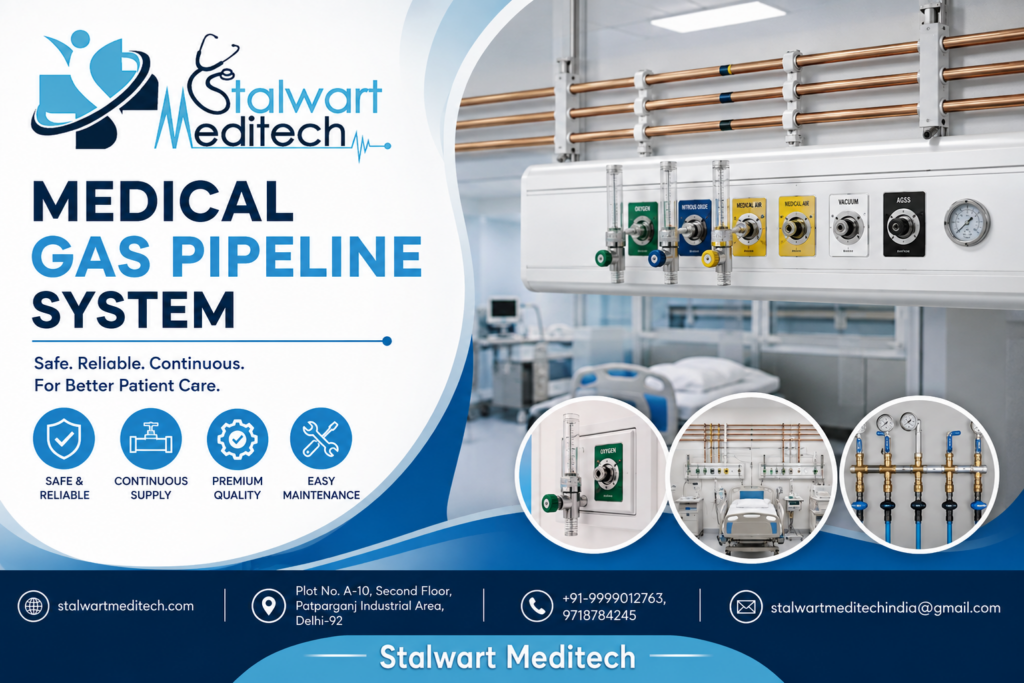
Every hospital runs on more than doctors and diagnostics. Behind the walls, a network of pipes silently delivers oxygen, vacuum, and medical air to every bed, ward, and operation theatre. This network is called a Medical Gas Pipeline System, and it is one of the most critical yet overlooked pieces of hospital infrastructure.
A well-designed Medical Gas Pipeline isn’t just plumbing. It’s a life-support system. When it works correctly, nobody notices it. When it fails, the consequences can be fatal. That’s why hospital owners, biomedical engineers, and purchase managers need to understand exactly what goes into building, selecting, and maintaining this system.
A Medical Gas Pipeline System is a network of pipes, valves, alarms, and outlets that safely delivers medical gases like oxygen, nitrous oxide, medical air, and vacuum suction to patient care areas. It must comply with NFPA 99, HTM 02-01, and ISO 7396-1 standards to ensure patient safety and uninterrupted supply.
Key Takeaways
- A Medical Gas Pipeline System delivers oxygen, medical air, nitrous oxide, and vacuum directly to patient care points.
- Compliance with NFPA 99, ISO 7396-1, and HTM 02-01 is non-negotiable for patient safety.
- Proper installation reduces gas wastage, cross-connection risk, and equipment downtime.
- Alarm systems and zone valves are essential for early fault detection.
- Routine maintenance extends system life and protects NABH accreditation.
- Copper pipelines remain the industry standard due to purity and corrosion resistance.
What Is a Medical Gas Pipeline System?
A Medical Gas Pipeline System connects a central gas source — cylinders, manifolds, or plants — to outlets at patient bedsides, ICUs, and operation theatres through a sealed pipe network. Instead of manually changing oxygen cylinders at every bed, staff simply plug equipment into a wall outlet.
This setup reduces manual handling, prevents supply gaps, and gives clinicians immediate access to life-saving gases.
How the System Works
The process is straightforward once you see it laid out:
- Gas is generated or stored at a central source (oxygen plant, manifold, or vacuum pump).
- It travels through medically pure copper pipelines.
- Zone valves control gas flow to specific wards or floors.
- Area alarm panels monitor pressure in real time.
- Terminal outlets deliver gas directly at the patient’s bedside.
Each stage includes safety checks, so if pressure drops in one zone, staff get an alert before it becomes a patient safety issue.
Types of Medical Gases Used in Hospitals
| Gas Type | Common Use |
| Oxygen (O2) | Respiratory support, ICU, OT |
| Medical Air | Ventilators, respiratory therapy |
| Nitrous Oxide | Anesthesia |
| Vacuum (Suction) | Surgical suction, airway clearance |
| Nitrogen | Surgical tools, pneumatic instruments |
| Carbon Dioxide | Laparoscopic surgery |
Key Components
- Manifold rooms – house cylinder banks or bulk gas sources
- Medical air plants – generate compressed medical air
- Vacuum plants – create suction for surgical use
- Copper pipelines – transport gas safely without contamination
- Zone valve boxes – isolate gas supply during maintenance or emergencies
- Area alarm panels – monitor pressure and alert staff to faults
- Terminal units (outlets) – deliver gas at the point of care
Benefits of a Well-Designed Medical Gas Pipeline
- Continuous supply without manual cylinder changes
- Reduced infection risk through sealed, contamination-free delivery
- Faster emergency response with instant gas access at every bed
- Lower long-term cost compared to repeated cylinder logistics
- Improved NABH and JCI audit outcomes
- Centralized monitoring for faster fault detection
Features to Look For
When evaluating a system or vendor, prioritize:
- Medically pure, degreased copper piping
- Brazing done with oxygen-free nitrogen purging
- Redundant gas sources for zero downtime
- Digital area alarm systems with audible and visual alerts
- Color-coded outlets as per international standards
- Trained installation teams with documented certifications
Applications Across Hospital Departments
| Department | Typical Gas Requirement |
| Operation Theatre | Oxygen, Nitrous Oxide, Medical Air, Vacuum, N2O |
| ICU/ICCU | Oxygen, Medical Air, Vacuum |
| Emergency Ward | Oxygen, Vacuum |
| Labour Room | Oxygen, Nitrous Oxide, Vacuum |
| General Wards | Oxygen, Vacuum |
| Dialysis Unit | Medical Air, Vacuum |
Gynecologists and urologists, for example, rely heavily on precise gas control during minimally invasive procedures, where even a slight pressure fluctuation can disrupt a surgery.
Standards & Compliance
A compliant Medical Gas Pipeline System should follow:
- NFPA 99 (USA) – Health Care Facilities Code
- HTM 02-01 (UK) – Medical Gas Pipeline Systems guidance
- ISO 7396-1 – International standard for pipeline systems
- NABH Guidelines – Required for Indian hospital accreditation
- IS 15723 – Indian standard for medical gas pipeline systems
Non-compliance doesn’t just risk penalties — it risks patient lives. Purchase managers should always request compliance documentation before finalizing a vendor.
Buying Guide
Choosing the right system depends on several factors. Here’s what hospital administrators and biomedical engineers should evaluate:
| Factor | What to Check |
| Bed Capacity | Determines pipeline sizing and outlet count |
| Departments Served | OT and ICU need higher redundancy |
| Vendor Experience | Look for hospital-specific project history |
| Compliance Certificates | NFPA, ISO, NABH documentation |
| After-Sales Support | Availability of AMC and emergency service |
| Material Quality | Medically pure copper, not standard-grade |
Tip: Always ask vendors for past installation references at hospitals of similar bed strength. This tells you more than any brochure.
Maintenance Tips
- Schedule quarterly pressure testing across all zones
- Inspect alarm panels monthly to confirm they trigger correctly
- Keep manifold rooms clean, dry, and ventilated
- Maintain a logbook for every inspection and repair
- Train nursing staff to recognize alarm signals
- Replace worn outlet valves before they fail, not after
| Maintenance Task | Frequency |
| Pressure testing | Quarterly |
| Alarm panel check | Monthly |
| Leak detection survey | Bi-annually |
| Manifold inspection | Monthly |
| Full system audit | Annually |
Common Mistakes to Avoid
- Using non-medical-grade copper pipes to cut costs
- Skipping nitrogen purging during brazing, which causes internal contamination
- Ignoring redundancy planning for high-dependency areas like ICU and OT
- Delaying alarm system testing
- Choosing vendors without proper healthcare project experience
- Overlooking documentation needed for NABH renewal
Industry Best Practices
- Involve biomedical engineers early in system design, not just at installation
- Always plan for 20-30% future capacity expansion
- Conduct a third-party validation after installation
- Maintain AMC (Annual Maintenance Contracts) with certified vendors
- Document every gas outlet with a unique zone identifier for faster troubleshooting
Cost vs Benefit Overview
| Investment Area | Long-Term Benefit |
| Premium copper piping | Fewer leaks, longer lifespan |
| Redundant gas sources | Zero downtime during maintenance |
| Digital alarm systems | Faster fault detection, safer wards |
| Certified installation | Smoother NABH/JCI audits |
| AMC with vendor | Predictable maintenance costs |
Frequently Asked Questions
1. What is a Medical Gas Pipeline System used for?
It delivers medical gases like oxygen, medical air, and vacuum directly to patient care areas through a centralized pipe network.
2. Which standards apply to Medical Gas Pipeline installation in India?
IS 15723 and NABH guidelines are the primary references, along with international standards like ISO 7396-1.
3. How often should a Medical Gas Pipeline System be inspected?
Pressure testing should happen quarterly, with a full system audit conducted annually.
4. Why is copper used for medical gas pipelines?
Copper is corrosion-resistant, non-reactive, and maintains gas purity, making it the global standard.
5. Can a Medical Gas Pipeline System fail without warning?
Rarely, if alarm panels are functioning correctly. Regular testing ensures early detection of pressure drops or leaks.
6. Is a Medical Gas Pipeline System mandatory for NABH accreditation?
Yes, a compliant system is a core requirement for NABH-accredited hospitals.
7. How long does installation typically take?
Timelines vary by hospital size, but a mid-sized facility usually takes several weeks from design to commissioning.
8. What’s the difference between a manifold and a plant?
A manifold connects cylinder banks for gas supply, while a plant (like an oxygen or vacuum plant) generates gas on-site.
9. Do smaller clinics need a full pipeline system?
Smaller setups may use simplified systems, but any facility with ICU, OT, or ventilator beds needs a proper pipeline.
10. Who should install a Medical Gas Pipeline System?
Only certified vendors with documented healthcare project experience and compliance certifications should handle installation.
Conclusion
A Medical Gas Pipeline System isn’t a line item you tick off during hospital construction. It’s a safety-critical investment that protects patients, supports clinical teams, and safeguards your accreditation status for years to come.
Getting it right the first time — with the correct materials, compliant design, and reliable after-sales support — saves hospitals from costly retrofits and, more importantly, from avoidable risk.
Stalwart Meditech designs, installs, and maintains hospital-grade Medical Gas Pipeline Systems built for compliance, safety, and long-term reliability. If you’re planning a new facility or upgrading an existing one, talk to our team for a system built around your hospital’s actual needs.
Visit: https://stalwartmeditech.com/contact-us/
Call: +91-9999012763, 9718784245
Email: stalwartmeditechindia@gmail.com
Address: Plot No. A-10, Second Floor, Patparganj Industrial Area, Delhi-92,
Address -: 4/2544, Street No.-11, Main Road, Govardhan Behari Colony, Shahdra, Delhi-32