
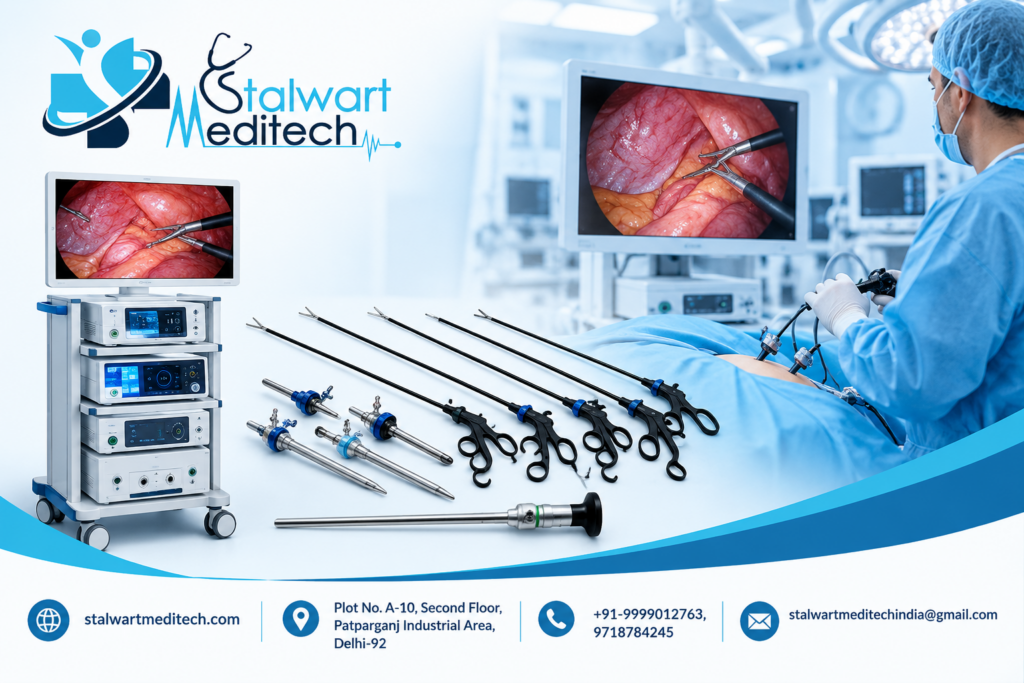
Laparoscopy equipment is the set of devices used to perform minimally invasive surgery through small incisions. A typical setup combines a laparoscope, camera system, monitor, light source, CO₂ insufflator, instruments, and trocars. Many also include electrosurgical and recording units. Together they provide visualization, illumination, access, and working space.
For hospitals, buying Laparoscopy Equipment is a workflow decision, not a single-device purchase. Visualization, insufflation, energy, instrumentation, and supporting equipment all need to work together. Stalwart Meditech, founded in 2013, focuses on medical equipment and healthcare infrastructure solutions and lists laparoscopy among its core product categories. This guide explains the main equipment types, how they fit together, and how to select them.
Quick Answer
Laparoscopy equipment includes the devices used in minimally invasive abdominal and pelvic surgery. A typical laparoscopic setup includes a laparoscope, camera system, monitor, light source, CO₂ insufflator, surgical instruments, trocars, and often an electrosurgical unit and recording system. Exact configurations vary by manufacturer, procedure, and hospital infrastructure.
What Is Laparoscopy Equipment?
Laparoscopy is a minimally invasive technique in which surgeons operate through small incisions using a camera and specialized instruments, instead of one large opening. Laparoscopic surgery equipment makes this possible by covering several functions:
- Visualization: the laparoscope, camera, and monitor
- Illumination: the light source and light cable
- Insufflation: a CO₂ insufflator that supports working space
- Surgical access: trocars and cannulas
- Instrumentation: graspers, scissors, dissectors, and more
- Energy: electrosurgical equipment where appropriate
- Supporting OT equipment: recording systems, carts, and displays
The exact configuration depends on the procedure, specialty, hospital infrastructure, and surgeon requirements.
Types of Laparoscopy Equipment
A. Laparoscopy Camera System
The camera system captures the image from the laparoscope and prepares it for display. It usually has a camera head, a camera control unit (CCU) for image processing, and a connected surgical monitor.
Systems are available in HD and a 4K laparoscopy camera system format. When comparing, look beyond resolution at color reproduction, clarity, and how well the processing suits your displays. Hospitals researching an endoscopy camera system will find the same evaluation criteria apply.
B. Laparoscopy Light Source
The light source illuminates the surgical field through a light cable and the laparoscope. Key considerations include:
- Light intensity and adjustability
- Compatibility with the laparoscope and cable
- Ease of control
- Reliability in daily use
- Integration with the camera system
C. CO₂ Insufflator
An insufflator delivers carbon dioxide in a controlled way to create working space for the procedure. When comparing models, review:
- Flow control
- Pressure monitoring and display
- Built-in safety features and alarms
- Compatibility with tubing and accessories
Specific settings are clinical decisions and are not covered here.
D. Laparoscopy Instruments
Laparoscopy instruments and laparoscopic instruments come in several categories:
- Graspers
- Scissors
- Dissection instruments
- Needle holders
- Suction and irrigation instruments
- Trocar-related instruments
- Specialized instruments for specific specialties
Instrument selection depends on the procedure and surgical specialty, so involve your surgeons early.
E. Electrosurgical Equipment
Electrosurgical units can form part of a laparoscopic setup for appropriate cutting or coagulation applications. Compatibility between the generator, instruments, and cables should be confirmed from manufacturer documentation. Hospitals often evaluate electro surgery units alongside the rest of the system.
F. Laparoscopic Trocars and Access Components
Trocars and cannulas provide access ports through which instruments and the laparoscope enter. Consider the available sizes, the sealing design, whether they are reusable or disposable, and compatibility with your instruments.
G. Supporting Equipment
A complete setup often includes:
- Medical-grade monitors and surgical displays
- Recording systems
- Insufflation accessories
- Irrigation and suction systems where applicable
- Equipment carts or integration solutions
Main Components of a Laparoscopy System
| Component | Primary Function |
| Laparoscope | Provides optical access and visualization |
| Camera System | Captures and processes images |
| Monitor | Displays the surgical image |
| Light Source | Provides illumination |
| CO₂ Insufflator | Supports controlled insufflation |
| Instruments | Enable surgical manipulation |
| Electrosurgical Unit | Supports appropriate energy-based applications |
| Recording System | Supports compatible image/video documentation |
| Accessories | Support system operation and integration |
Exact system configurations vary by manufacturer and application.
How Does a Laparoscopy System Work?
At a high level, the equipment works as a chain:
- The laparoscope provides optical access and visualization.
- The camera captures the image.
- The camera control unit processes the signal.
- The monitor displays the image for the surgical team.
- The light source illuminates the field through the laparoscope.
- The insufflator supports the required working environment.
- Instruments provide the mechanical functions the surgeon needs.
A weak link anywhere in this chain affects the whole workflow, which is why compatibility matters so much.
Key Features to Look for in Laparoscopy Equipment
Image quality. Evaluate resolution, clarity, color reproduction, and image processing together, ideally through a live demonstration.
System compatibility. Check that the camera, monitor, light source, laparoscope, recording equipment, and existing OT infrastructure work together.
Ergonomics. Consider handling, control layout, display visibility, and equipment placement in your operating theatre.
Safety features. Review monitoring, alarms, protection systems, and the safety functions the manufacturer specifies.
Ease of cleaning and maintenance. Match equipment to your reprocessing, disinfection, sterilization, and maintenance capabilities.
Serviceability. Ask about warranty terms, technical support, spare parts, scheduled maintenance, and service availability in your region.
HD vs 4K Laparoscopy Equipment
| Feature | HD | 4K |
| Resolution | High definition | Ultra-high definition |
| Image Detail | Detailed | Higher image detail |
| Display | HD-compatible | 4K-compatible where required |
| Image Processing | System dependent | System dependent |
| Infrastructure | Existing HD setup | May require compatible 4K components |
| Selection | Based on facility needs | Based on visualization and infrastructure requirements |
4K is not automatically the right choice for every facility. A 4K camera paired with a non-compatible monitor or recorder will not deliver its full potential. Evaluate the complete ecosystem, including compatibility, budget, clinical requirements, and infrastructure.
Applications of Laparoscopy Equipment
Laparoscopic equipment is used across many specialties:
- General surgery
- Gynecology, including related gynecology and hysteroscopy equipment needs
- Urology, with dedicated urology equipment
- Gastrointestinal procedures
- Other minimally invasive surgical environments
Treatment decisions and procedural technique belong to the clinical team. This article does not make claims about recovery times, complications, or patient outcomes.
How to Choose the Right Laparoscopy Equipment
Step 1: Identify clinical requirements. List the procedures and specialties the equipment must support.
Step 2: Evaluate existing OT infrastructure. Review available monitors, displays, electrical infrastructure, recording systems, and other equipment.
Step 3: Define the required components. Decide whether you need a complete system or selected components.
Step 4: Compare technical specifications. Assess resolution, compatibility, controls, operating features, and accessories using manufacturer documentation.
Step 5: Check manufacturer support. Review warranty, installation, servicing, training, documentation, and spare-part availability.
Step 6: Consider total cost of ownership. Include the initial investment, accessories, maintenance, consumables where applicable, service costs, and replacement requirements.
Common Mistakes When Buying Laparoscopy Equipment
- Choosing on price alone. Compare total cost of ownership instead.
- Focusing only on camera resolution. Evaluate the full imaging chain.
- Ignoring compatibility. Request written confirmation that components work together.
- Overlooking accessories. List cables, tubing, and adapters up front.
- Not checking service support. Confirm response arrangements and spare-part availability.
- Ignoring maintenance requirements. Ask what routine upkeep involves and who performs it.
- Buying components in isolation. Map the whole workflow first.
- Not involving clinical and biomedical teams. Include surgeons, nurses, and engineers in evaluations.
- Skipping product documentation. Read manuals and specification sheets before purchase.
Laparoscopy Equipment Manufacturer vs Supplier
These terms are often used interchangeably, but they differ:
- Manufacturer: designs and produces the equipment.
- Supplier: provides equipment sourced from one or more makers.
- Distributor: holds authorized rights to sell and often service a brand.
- System integrator: combines devices into a working, connected setup.
Whether you are looking for a laparoscopy equipment manufacturer, a laparoscopy equipment supplier, or comparing laparoscopy equipment manufacturers in India, evaluate the product range, technical documentation, product support, service network, installation, warranty, spare parts, and customization or integration options. Ask any company to clarify its exact role for each product.
Laparoscopy Equipment by Stalwart Meditech
Based on its website, Stalwart Meditech lists Laparoscopy Equipment among its medical product categories. It offers a Complete Laparoscopy System Catalog and a Laparoscopy Instruments Catalog. Related categories include:
- Endoscopy Camera System
- Gynecology
- Hysteroscopy
- Urology
- Medical Grade Monitors
- Electro Surgery Units
- Modular Operation Theatre
The company states it was founded in 2013 and focuses on medical equipment and healthcare infrastructure solutions. For specifications, configurations, and availability, request current product documentation directly from Stalwart Meditech. You can also explore its range as a medical equipment manufacturer in India.
Maintenance Tips for Laparoscopy Equipment
- Follow the manufacturer’s instructions for every device.
- Inspect equipment before each use.
- Check cables and connectors for wear or damage.
- Handle optical components carefully.
- Follow product-specific cleaning and disinfection requirements.
- Store instruments appropriately.
- Schedule regular technical maintenance.
- Replace damaged components through authorized or service-approved channels.
- Keep equipment documentation and service records.
Reprocessing and sterilization parameters differ by product, so always confirm them in the manufacturer’s documentation.
Laparoscopy Equipment Buying Checklist
Clinical requirements identified
Required components listed
Camera resolution evaluated
Monitor compatibility checked
Light source compatibility checked
Insufflator requirements evaluated
Instruments selected
Accessories verified
Safety features reviewed
Maintenance requirements understood
Warranty reviewed
Service support confirmed
Spare-parts availability checked
Total ownership cost evaluated
Frequently Asked Questions
1. What is laparoscopy equipment?
Laparoscopy equipment is the group of devices used in minimally invasive surgery performed through small incisions. It typically includes a laparoscope, camera system, monitor, light source, CO₂ insufflator, instruments, and trocars, along with electrosurgical and recording equipment where needed. Configurations vary by procedure and hospital requirements.
2. What are the main components of a laparoscopy system?
The main components are the laparoscope, camera system, monitor, light source, CO₂ insufflator, and surgical instruments. Many setups also include an electrosurgical unit, recording system, and accessories such as cables and tubing. Exact components vary by manufacturer and by how the hospital configures its operating theatre.
3. Is 4K laparoscopy equipment better than HD?
4K offers higher image detail, but it is not automatically the best choice. It may require compatible monitors, recorders, and other components to perform as intended. Hospitals should weigh clinical needs, existing infrastructure, budget, and compatibility before deciding between an HD and a 4K system.
4. How do hospitals choose laparoscopy equipment?
Hospitals typically start by defining clinical requirements, then review existing OT infrastructure and required components. Next they compare technical specifications, check manufacturer support, and calculate total cost of ownership. Involving surgeons, nurses, and biomedical engineers helps ensure the chosen equipment fits the real workflow.
5. What should I check before buying from a laparoscopy equipment supplier?
Check the product range, technical documentation, warranty, installation support, training, and spare-part availability. Confirm whether the company is a manufacturer, distributor, or integrator, and ask about service coverage in your region. Request manufacturer documentation for specifications instead of relying on general claims.
Conclusion
The right laparoscopy equipment is the one that fits your clinical needs, your existing infrastructure, and your long-term service expectations. Looking at the complete workflow, from visualization to instruments to after-sales support, leads to better purchasing decisions than comparing single specifications.
Planning to equip or upgrade your operating theatre? Contact Stalwart Meditech to request its Complete Laparoscopy System and Laparoscopy Instruments catalogs and discuss your hospital’s requirements with the team.
Call: +91-9999012763, 9718784245
Email: stalwartmeditechindia@gmail.com
Address: Plot No. A-10, Second Floor, Patparganj Industrial Area, Delhi-92,
Address -: 4/2544, Street No.-11, Main Road, Govardhan Behari Colony, Shahdra, Delhi-32