
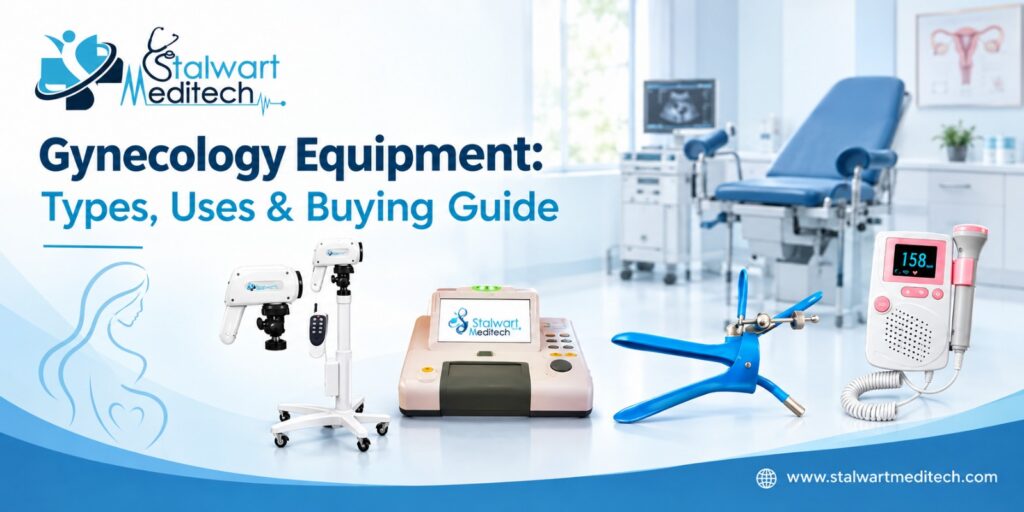
Gynecology equipment is the backbone of every women’s healthcare setup, from a single-doctor clinic to a multi-specialty hospital. As gynecological care has moved toward more precise diagnostics and minimally invasive procedures, hospitals and clinics across India are re-evaluating what equipment they need, how it fits their workflow, and who they buy it from. Choosing the right gynecology equipment isn’t just about ticking a checklist — it depends on the clinical application, the type of procedure performed, facility infrastructure, patient-care workflow, compatibility with existing systems, budget, and the availability of long-term maintenance and service support. This guide walks through the major categories of gynecology equipment, how each is used, and what to look for before making a purchase decision.
Quick Answer
Gynecology Equipment refers to the instruments and devices used for gynecological examination, diagnosis, and surgical or endoscopic procedures in women’s healthcare. When buying it, healthcare facilities should evaluate clinical requirements, build quality, compatibility with existing systems, sterilization needs, maintenance support, documentation, and after-sales service — not price alone.
What is Gynecology Equipment?
Gynecology equipment is a broad term covering the devices, systems, and instruments used across women’s reproductive healthcare — from a routine consultation to a complex surgical procedure. It typically includes equipment used for:
- Gynecological examination and consultation
- Diagnostic evaluation
- Minor outpatient procedures
- Gynecological surgical procedures
- Endoscopic (hysteroscopic and laparoscopic) procedures
- Broader women’s reproductive healthcare needs, such as antenatal monitoring
It’s useful to distinguish between two related terms. Gynecology equipment usually refers to larger systems and devices — monitors, imaging units, energy platforms, workstations. Gynecology instruments refers to the handheld tools used directly during examination or surgery, such as specula, forceps, and scissors. In practice, a fully equipped gynecology unit or operating room uses both together.
Types of Gynecology Equipment
Gynecological Examination Equipment
Routine gynecological examinations rely on equipment such as examination tables, specula, light sources, and colposcopes for magnified visual assessment of the cervix and lower genital tract. Colposcopy workstations, which combine a colposcope with a digital camera and monitor, are increasingly used in outpatient settings to support documentation and clearer visualization during examination.
Gynecology Surgical Equipment
Gynecological surgical procedures — whether open, vaginal, or minimally invasive — depend on a combination of surgical equipment and instruments. This includes electrosurgical units, suction and irrigation systems, surgical lighting, and instrument sets suited to the specific procedure being performed. The exact combination varies significantly depending on the type of surgery and the facility’s surgical protocols.
Hysteroscopy Equipment
Hysteroscopy is one of the most widely used diagnostic and operative techniques in modern gynecology, allowing direct visualization of the uterine cavity. A hysteroscopy setup generally includes:
- A hysteroscope (rigid or flexible)
- A camera system for visualization
- A light source
- A monitor for the surgical team to view the procedure
- A fluid management or irrigation/distension system to maintain a clear uterine cavity
These components need to work together seamlessly, which is why compatibility between the scope, camera, and monitor is a key purchasing consideration, discussed further below.
Gynecology Instruments
Gynecology instruments cover a wide functional range, generally grouped as:
- Examination instruments — specula and related diagnostic tools
- Grasping instruments — forceps used to hold or stabilize tissue
- Cutting instruments — scissors and related cutting tools
- Dilatation instruments — dilators used to gradually widen the cervical canal
- Retractors — used to hold tissue or structures aside for visibility
- Surgical instruments — broader sets used across different gynecological procedures
This guide is intended for equipment selection and purchasing reference only; it does not provide instructions on how to perform any clinical procedure. Instrument use should always follow the clinician’s training and the applicable clinical protocol.
Electrosurgical Equipment
Electrosurgical units generate controlled energy used in various gynecological procedures for tasks such as tissue cutting or coagulation, depending on the clinical requirement. At a high level, these systems allow surgeons to work with more control during certain procedures, and are typically selected based on the range of procedures a facility performs and the safety features the unit offers.
Supporting Operating Room Equipment
Gynecology equipment rarely functions in isolation. In an operating theatre, it typically works alongside:
- Medical-grade monitors for visualization
- Surgical lighting
- Operating tables
- Electrosurgical units
- Endoscopic visualization systems (cameras, light sources)
- Other general operating-theatre equipment
A well-planned OT setup ensures all these systems are compatible with each other, reducing workflow disruptions during procedures.
Uses of Gynecology Equipment
Different categories of gynecology equipment support different points in the patient-care journey:
- Routine gynecological examination — specula, examination tables, and light sources support day-to-day consultations.
- Diagnostic procedures — colposcopes and related imaging tools help with visual assessment.
- Hysteroscopy — used for both diagnostic evaluation of the uterine cavity and, where clinically indicated, operative procedures.
- Minimally invasive gynecological procedures — endoscopic visualization systems support procedures performed through small incisions or natural orifices.
- Surgical procedures — a combination of surgical instruments, electrosurgical units, and OT support equipment is used, depending on the procedure.
- Patient monitoring — medical-grade monitors and, in antenatal care, fetal monitoring devices such as CTG machines and fetal dopplers.
- Operating-room support — lighting, tables, and imaging systems that support the surgical team.
It’s important to note that equipment supports clinical decision-making and procedural execution — it does not, by itself, determine or guarantee a medical outcome. Outcomes depend on clinical judgment, patient factors, and procedural technique.
Key Features to Consider When Choosing Gynecology Equipment
Quality & Construction
Look at the materials used, manufacturing quality, and overall build durability. Ask for relevant product documentation so you understand what you’re actually buying, rather than relying on marketing claims alone.
Ergonomics
Equipment and instruments should be practical for the professionals who will use them daily. Instrument grip, weight, and design affect comfort and usability during long clinic hours or procedures.
Compatibility
If you’re building or upgrading a hysteroscopy or endoscopy setup, the camera, scope, light source, and monitor need to work together. Mismatched components can lead to poor image quality or workflow issues, so compatibility should be confirmed before purchase — not after installation.
Sterilization & Cleaning Requirements
Reusable instruments and equipment must be cleaned and sterilized according to the manufacturer’s instructions and applicable healthcare facility protocols. Buyers should check what sterilization methods a given instrument or device supports before purchase.
Maintenance
Ask about servicing requirements, spare parts availability, preventive maintenance schedules, and access to technical support. Equipment that’s difficult to service can lead to costly downtime.
Documentation & Compliance
Buyers should verify relevant product documentation and confirm that products meet the regulatory requirements applicable to their market. In India, medical devices fall under the regulatory framework administered by the Central Drugs Standard Control Organisation (CDSCO) under the Medical Device Rules, 2017.1
Warranty & After-Sales Support
After-sales support — including warranty terms, response times, and service network reach — should be evaluated before purchase, not as an afterthought once equipment is already installed.
How to Choose the Right Gynecology Equipment
- Identify clinical requirements. Understand what procedures and examinations your facility performs or plans to perform.
- Determine the procedures and applications. Match equipment categories to your actual clinical workflow — don’t over- or under-equip.
- Review technical specifications. Compare specifications across shortlisted products against your facility’s requirements.
- Check compatibility with existing infrastructure. Especially relevant for cameras, scopes, monitors, and energy platforms.
- Evaluate quality and documentation. Request datasheets, certifications, and compliance documentation.
- Compare service and warranty support. Look at response times, service network coverage, and spare parts availability.
- Calculate total cost of ownership. Factor in installation, consumables, servicing, and eventual replacement — not just the purchase price.
- Choose a suitable supplier or manufacturer. Evaluate their product range, technical knowledge, and post-sale support capability.
The right choice depends on your facility’s specific clinical and operational needs — not simply on choosing the most expensive or most feature-heavy option available.
Comparison Table: Common Categories of Gynecology Equipment
| Equipment Category | Primary Use | Typical Setting |
| Colposcope / Colposcopy Workstation | Magnified visual examination of the cervix | Outpatient clinic, examination room |
| Hysteroscope with camera & light source | Diagnostic and operative visualization of the uterine cavity | Hysteroscopy suite, OT |
| Fluid management / irrigation system | Uterine cavity distension during hysteroscopy | Hysteroscopy suite, OT |
| Electrosurgical unit | Energy-based tissue cutting/coagulation during procedures | Operating theatre |
| Surgical instrument sets (forceps, scissors, retractors, dilators) | Direct handling during examination or surgery | Examination room, OT |
| CTG machine / fetal doppler | Fetal and maternal monitoring | Antenatal clinic, labour room |
| Medical-grade monitor | Visualization during endoscopic procedures | OT, hysteroscopy suite |
This table is for general reference. Always confirm exact specifications with the manufacturer before purchase.
Common Mistakes When Buying Gynecology Equipment
- Choosing equipment based only on price — Solution: weigh quality, compatibility, and support alongside cost.
- Ignoring compatibility — Solution: confirm that cameras, scopes, monitors, and instruments work together before ordering.
- Not checking specifications — Solution: request detailed datasheets and compare them against your requirements.
- Overlooking maintenance requirements — Solution: ask about service intervals and spare parts availability upfront.
- Ignoring sterilization requirements — Solution: confirm compatible sterilization methods before purchase.
- Failing to assess after-sales support — Solution: evaluate the supplier’s service network and response times.
- Purchasing unnecessary equipment — Solution: base purchases on actual clinical workflow, not assumptions.
- Not considering future expansion — Solution: choose systems that can scale or integrate with future additions.
- Failing to verify documentation — Solution: request compliance and certification documents before finalizing an order.
Gynecology Equipment Manufacturer vs Supplier
Buyers often use “manufacturer” and “supplier” interchangeably, but the distinction matters for procurement decisions. A manufacturer designs and produces the equipment, which typically means deeper technical knowledge of the product, more direct access to documentation, and — in some cases — customization options. A supplier or distributor sources equipment, sometimes from multiple manufacturers, and focuses on distribution, local availability, and logistics.
When evaluating either, consider:
- Product portfolio and range
- Manufacturing capabilities (for manufacturers)
- Technical knowledge and ability to answer detailed queries
- Availability of documentation and compliance records
- Customization options, where applicable
- Installation support
- Service network reach
- Spare parts availability
- Warranty terms
Neither option is universally “better” — the right choice depends on your facility’s specific procurement priorities, such as whether you value direct manufacturer relationships or broader product access through a distributor.
Why Choose Stalwart Meditech for Gynecology Equipment?
Stalwart Meditech is a Delhi-based medical equipment manufacturer in India, founded in 2013 and operating under the guiding philosophy “Care with Concern.” The company has built its reputation around designing and manufacturing modular operating theatres that comply with NABH standards, alongside a wider portfolio of hospital and clinical equipment.
Within women’s healthcare, Stalwart Meditech’s gynecology equipment range includes examination and diagnostic equipment such as colposcopes and colposcopy workstations, fetal monitoring devices like CTG machines and fetal dopplers, and gynecology instruments including specula and forceps. The company also offers a dedicated hysteroscopy equipment range and an endoscopy camera system line that supports visualization needs across gynecological and other endoscopic procedures.
| What Stalwart Meditech Offers | Relevance to Buyers |
| In-house manufacturing focus | Closer access to technical and product knowledge |
| Gynecology, hysteroscopy & endoscopy camera product lines | Equipment options across examination, diagnostic, and procedural needs |
| Hospital-focused product range (including modular OT solutions) | Suitable for facilities scaling up infrastructure alongside equipment needs |
| Customer support orientation | Emphasis on service relationships alongside product supply |
Hospitals and clinics evaluating gynecology equipment suppliers can review Stalwart Meditech’s full gynecology equipment range or get in touch through the contact page to discuss specific requirements.
How Much Does Gynecology Equipment Cost?
Gynecology equipment pricing varies widely and depends on several factors, including:
- Equipment type (an examination speculum and a full hysteroscopy tower fall at very different price points)
- Technical specifications and features
- Brand and manufacturer
- Configuration and included accessories
- Order quantity
- Customization requirements
- Installation needs
- Ongoing service and maintenance requirements
Because of this variability, this article does not publish specific price figures, and buyers should always request a formal, itemized quotation from suppliers based on their exact requirements. More importantly, facilities should evaluate the total cost of ownership — including installation, consumables, servicing, and eventual component replacement — rather than comparing only the upfront purchase price. A lower initial price can sometimes result in higher costs over the equipment’s lifespan if service support or spare parts availability is limited.
Gynecology Equipment Maintenance Tips
- Always follow the manufacturer’s instructions for use and care
- Perform appropriate cleaning after each use, based on the instrument or device type
- Follow applicable sterilization protocols for your facility and equipment category
- Regularly inspect reusable instruments for wear, damage, or corrosion
- Schedule preventive maintenance rather than waiting for equipment to fail
- Store equipment correctly, in appropriate conditions and packaging
- Maintain detailed service records for every device
- Replace damaged or worn components promptly when required
- Use trained personnel or authorized service technicians for repairs and servicing
These are general maintenance principles; always refer to procedure-specific and manufacturer-specific guidance for any given device.
Frequently Asked Questions
1. What is gynecology equipment used for?
Gynecology equipment is used for gynecological examination, diagnosis, and surgical or endoscopic procedures related to women’s reproductive healthcare, ranging from routine consultations to operating-room procedures.
2. What is the difference between gynecology equipment and gynecology instruments?
Gynecology equipment” generally refers to larger systems and devices, such as monitors and imaging units, while “gynecology instruments” refers to handheld tools like specula and forceps used directly during examination or surgery.
3. What should hospitals check before buying gynecology equipment?
Hospitals should verify product quality and documentation, compatibility with existing systems, sterilization requirements, availability of technical support, and after-sales service before finalizing a purchase.
4. Why is maintenance important for gynecology equipment?
Regular maintenance helps equipment perform reliably, reduces the risk of unexpected downtime, and supports patient safety by keeping devices in proper working condition.
5. How do I choose between a gynecology equipment manufacturer and a supplier?
The right choice depends on your facility’s priorities — such as whether you value direct access to a manufacturer’s technical knowledge or the broader product range and logistics support a supplier may offer.
Looking for reliable gynecology equipment for your hospital or healthcare facility? Connect with Stalwart Meditech to discuss your requirements and explore suitable medical equipment solutions.
Visit Website :- https://stalwartmeditech.com/
Call: +91-9999012763, 9718784245
Email: stalwartmeditechindia@gmail.com
Address: Plot No. A-10, Second Floor, Patparganj Industrial Area, Delhi-92,
Address -: 4/2544, Street No.-11, Main Road, Govardhan Behari Colony, Shahdra, Delhi-32