
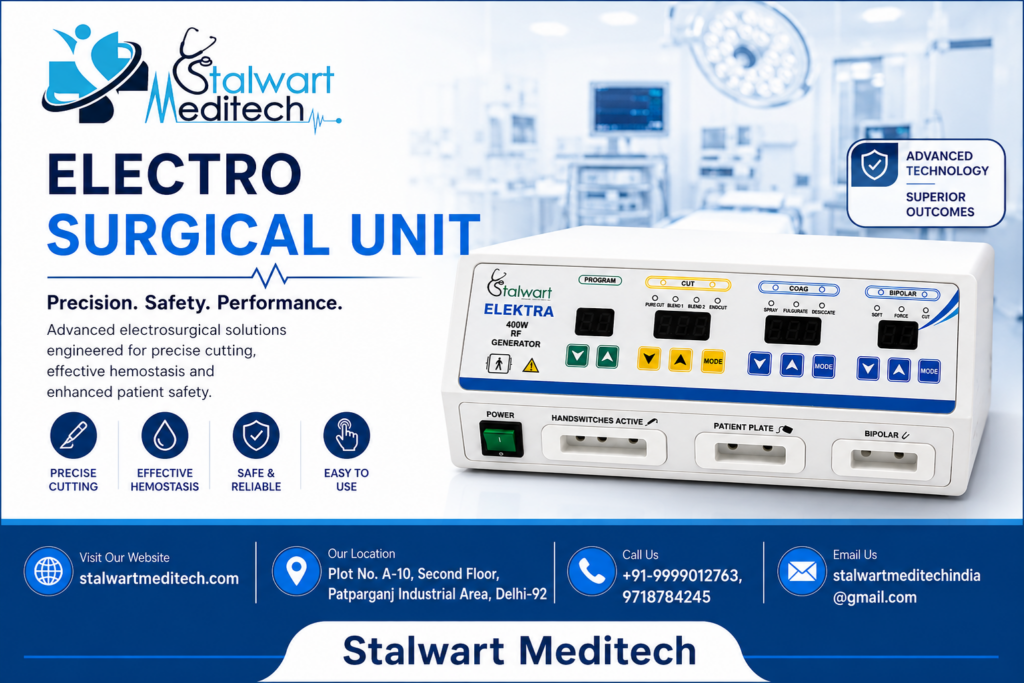
Walk into any modern operating room, and you’ll notice something interesting: scalpels, once the undisputed stars of surgery, now share the spotlight with a device most patients never hear about — the electro surgical unit. If you’ve ever wondered how surgeons make bloodless incisions, seal blood vessels in seconds, or remove tissue with pinpoint precision, the answer usually traces back to this one machine humming quietly at the edge of the surgical table.
For hospital procurement teams, clinic owners, and biomedical engineers, choosing the right electro surgical unit (ESU) isn’t just a technical decision — it directly affects patient safety, surgical outcomes, and long-term operational costs. This guide breaks down everything you need to know, from how these units work to what to check before you buy one in 2026.
What Is an Electro Surgical Unit?
An Electro Surgical Units is a medical device that uses high-frequency electrical current to cut tissue, coagulate (stop) bleeding, or destroy abnormal tissue during surgery. Unlike a traditional scalpel that relies purely on mechanical sharpness, an ESU passes electrical energy through the tissue, generating localized heat that cuts and seals simultaneously.
This is why electro surgery is often called “bloodless surgery” — the same energy that separates tissue also cauterizes the small blood vessels around the incision, reducing blood loss and improving visibility for the surgeon.
Think of it like a soldering iron for the human body: precise, controlled, and capable of doing two jobs — cutting and sealing — at once.
How Does an Electro Surgical Unit Work?
Every ESU works on a simple principle: electrical current generates heat when it meets resistance in tissue. The type of waveform the generator produces determines whether the effect is cutting, coagulation, or a blend of both.
- Continuous waveform — produces steady heat, ideal for clean cutting
- Interrupted (pulsed) waveform — produces higher peak voltage, ideal for coagulation
- Blended waveform — combines both effects for simultaneous cutting and sealing
Most units also include safety mechanisms like return electrode monitoring, which detects if the patient return pad isn’t properly attached — a small feature that prevents serious burns.
Quick Reference: ESU Modes and Their Purpose
| Mode | Waveform Type | Primary Use |
| Cut Mode | Continuous | Clean tissue incisions with minimal charring |
| Coagulation Mode | Interrupted/Pulsed | Stopping bleeding, sealing small vessels |
| Blend Mode | Mixed | Simultaneous cutting with controlled hemostasis |
| Fulguration | High-voltage spark | Surface coagulation over a wider area |
Note: The right mode depends on tissue type, procedure, and surgeon preference — most modern ESUs let you switch between modes instantly.
Types of Electro Surgical Units
Not all ESUs are built the same. Depending on the procedure and how the electrical circuit is completed, electro surgical units fall into a few broad categories.
Monopolar vs Bipolar vs Advanced Bipolar (Comparison Table)
| Type | How It Works | Best For | Limitation |
| Monopolar ESU | Current flows from active electrode through the body to a return pad | General surgery, larger tissue areas | Risk of stray burns if return pad is misplaced |
| Bipolar ESU | Current flows only between the two tips of forceps | Delicate procedures, neurosurgery, gynecology | Not ideal for large tissue volumes |
| Advanced Bipolar / Vessel Sealing | Combines pressure with energy to seal vessels up to 7mm | Laparoscopic and vascular surgery | Higher upfront investment |
Note: Many hospitals now maintain a mix of monopolar and bipolar systems to cover different departments and procedure types.
Where Are Electro Surgical Units Used?
ESUs have moved far beyond the general surgery department. Today, you’ll find them in:
- General & laparoscopic surgery — tissue dissection and hemostasis
- Gynecology — procedures like LEEP and laparoscopic sterilization
- ENT surgery — tonsillectomy and sinus procedures
- Dermatology — skin tag and lesion removal
- Urology — TURP and other resection procedures
- Cardiac and vascular surgery — precise vessel sealing
This wide applicability is exactly why hospitals across departments — not just operation theatres — are budgeting for ESUs in 2026.
Buying Guide: What to Check Before Purchasing an ESU
Buying an electro surgical unit isn’t like buying a printer — a wrong choice can affect surgical safety and departmental efficiency for years. Here’s a practical checklist to walk through with your procurement or biomedical team.
ESU Buying Guide Checklist
| Checklist Item | Why It Matters |
| Power output range (watts) | Determines the range of procedures the unit can support, from minor to major surgery |
| Monopolar + bipolar capability | A dual-mode unit adds flexibility across departments |
| Return electrode monitoring (REM) | Essential safety feature that prevents patient burns |
| Compatibility with accessories | Check if existing forceps, pencils, and pads will work with the new unit |
| Smoke evacuation support | Improves OR air quality and staff safety during long procedures |
| After-sales service & AMC | Downtime in surgery isn’t an option — check response times before buying |
| Regulatory certification | Confirm relevant approvals (CE, ISO, or local regulatory body) for your region |
Note: Use this checklist during vendor demos — a good supplier will walk you through each point without hesitation.
Step-by-Step: How Hospitals Typically Evaluate an ESU Before Purchase
- Define the department’s procedure mix — list the surgeries the unit will support
- Shortlist 2–3 vendors based on power range, safety features, and budget
- Request an on-site demo to test ergonomics and interface usability
- Verify certifications and warranty terms with the biomedical engineering team
- Check accessory and consumable costs — these add up over the unit’s lifetime
- Finalize based on total cost of ownership, not just the sticker price
Best Practices for Using Electro Surgical Units Safely
- Always confirm the return electrode is fully and correctly attached before starting
- Use the lowest effective power setting for the procedure — more isn’t always better
- Keep the active electrode clean and free of char buildup during long procedures
- Ensure alcohol-based prep solutions are fully dry before activating the ESU
- Train all OR staff periodically on updated safety protocols, not just at onboarding
Do’s and Don’ts of ESU Handling
| Do | Don’t |
| Inspect cables and pads before every use | Don’t use a return pad with visible damage or wear |
| Store the unit in a dry, dust-free environment | Don’t place flammable materials near an active electrode |
| Schedule regular preventive maintenance | Don’t skip calibration checks to save time |
| Keep a backup unit or accessories on standby | Don’t rely on a single unit for a high-volume OR |
Note: Most electrosurgical incidents are preventable and usually trace back to a skipped basic check — not equipment failure.
Common Mistakes to Avoid When Buying or Using an ESU
1. Choosing power output without matching it to actual procedure needs. A unit that’s overpowered for your typical caseload adds cost without adding value — and one that’s underpowered slows down surgeons.
2. Ignoring accessory compatibility. Some hospitals discover after purchase that their existing forceps or pencils don’t work with the new generator, leading to unplanned extra spending.
3. Overlooking staff training. Even the best ESU is only as safe as the team operating it. Skipping refresher training is one of the most common — and preventable — causes of electrosurgical incidents.
4. Not budgeting for maintenance. ESUs are precision electronic devices. Skipping annual maintenance contracts often leads to costlier repairs down the line.
Frequently Asked Questions
1. What is the main difference between monopolar and bipolar electro surgical units?
Monopolar units send current through the patient’s body to a return pad, making them suitable for larger tissue areas. Bipolar units confine current between two forceps tips, making them safer for delicate, localized procedures.
2. Is electro surgery safe for patients?
Yes, when used correctly with proper safety checks like return electrode monitoring, electro surgery is considered a safe and widely used surgical technique across the world.
3. How long does an electro surgical unit typically last?
With proper maintenance, most hospital-grade ESUs have a functional lifespan of 7–10 years, though this varies by usage volume and manufacturer.
4. Can one ESU be used across multiple surgical departments?
Many modern units support both monopolar and bipolar modes, making them versatile enough for general surgery, gynecology, ENT, and more — provided compatible accessories are available.
5. What safety features should a good ESU have?
Look for return electrode monitoring, adjustable power settings, audible/visual alarms, and isolated output circuitry as baseline safety features.
6. How do I know what power rating my department needs?
This depends on your typical case mix — general surgery and larger resections usually need higher wattage than dermatology or minor outpatient procedures. A vendor demo can help match specs to your actual needs.
Final Thoughts
Electro surgical units have quietly become one of the most essential tools in modern surgery — not flashy, but foundational. Whether you’re setting up a new operation theatre or upgrading aging equipment, the right ESU comes down to matching power, safety features, and accessory compatibility to your department’s real-world needs, not just the spec sheet.
At Stalwart Meditech, we work closely with hospitals and clinics to help them choose electro surgical units that fit their exact surgical workload — not a one-size-fits-all package. If you’re evaluating options for 2026, it’s worth having a conversation with our team before you finalize a vendor.
Visit: https://stalwartmeditech.com/contact-us/
Call: +91-9999012763, 9718784245
Email: stalwartmeditechindia@gmail.com
Address: Plot No. A-10, Second Floor, Patparganj Industrial Area, Delhi-92,
Address -: 4/2544, Street No.-11, Main Road, Govardhan Behari Colony, Shahdra, Delhi-32